
Disminuyendo el Dolor, Miedo y Ansiedad por las Agujas en la Población Pediátrica: Estrategias Basadas en Evidencia para el Profesional de Enfermería
Los niños y el miedo a las agujas
La administración de vacunas y la extracción de sangre son procedimientos comúnmente realizados en la población pediátrica que han demostrado tener un impacto emocional negativo a lo largo de toda la vida1. La evidencia revela que hasta un 68% de la población pediátrica ha reportado dolor, ansiedad, miedo o fobia a las agujas2,3,4,5. Esta experiencia es identificada como la principal barrera para la vacunación infantil2,4,5. Reconociendo la importancia de estos procedimientos para la salud física de esta población, es esencial que los profesionales de enfermería manejen eficazmente las respuestas físicas y emocionales asociadas5,6,7,8. Pues se ha probado que existe una asociación directa entre la ejecutoria clínica del profesional de enfermería y las experiencias de dolor y ansiedad en la población pediátrica durante los procedimientos con agujas7.

Estrategias para la disminución del dolor, miedo y ansiedad por las agujas
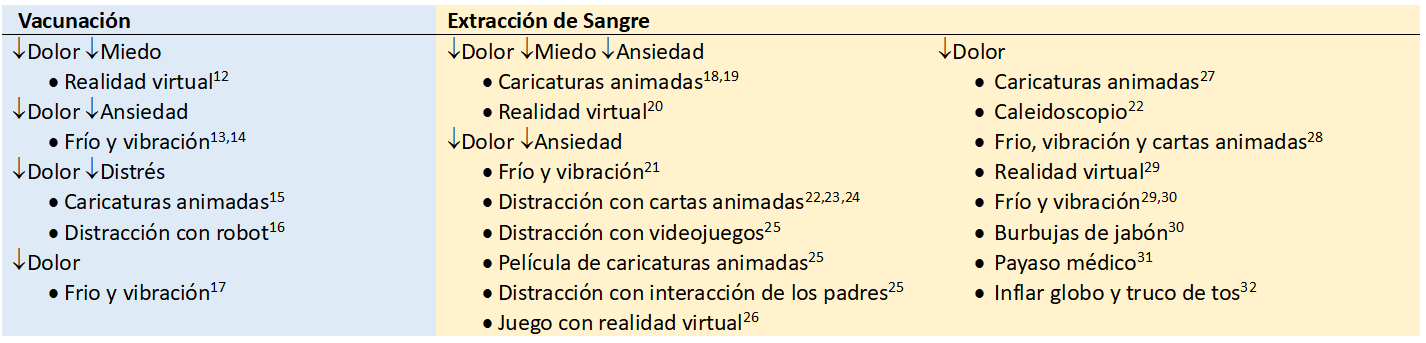
Estrategias No Farmacológicas
Autora: Elisabet Pérez-Rodríguez, PhDc, RN/ diciembre 2023
Aspectos para Considerar al Momento de Realizar Inserción de Aguja en Población Pediátrica
A continuación, una guía de acciones que puede utilizar el profesional de enfermería previo a la intervención de inserción de agujas en la población pediátrica:
- ★Explicar de manera sencilla en qué consiste el procedimiento utilizando palabras fáciles de entender para que el menor sepa lo que va a pasar antes, durante y después del procedimiento. Es importante no utilizar palabras despectivas como por ejemplo “puya”, en lugar de aguja. No obstante, se debe informar al menor que el procedimiento puede ser molestoso. Además, se puede practicar lo que va a suceder paso a paso en estilo de juego de roles, uso de libros o videos.
- ★Tomar en cuenta que la presencia de un familiar/cuidador es fundamental para el apoyo del menor.
- ★Estudios sugieren que se utilice un espacio privado, específicamente diseñado para pacientes pediátricos, en donde los ruidos y las luces estén disminuidos; un espacio más acogedor, que luzca menos clínico y por tanto les sea amigable.
Autora: Lilliana Hernández-Robles, PhD, MSN, RN /diciembre 2023
Referencias
- Orenius T, LicPsych, Säilä H, Mikola K, Ristolainen L. Fear of injections and needle phobia among children and adolescents: An overview of psychological, behavioral, and contextual factors. SAGE Open Nurs. 2018;4:237796081875944. doi:10.1177/2377960818759442
- Taddio A, Ipp M, Thivakaran S, et al. Survey of the prevalence of immunization non-compliance due to needle fears in children and adults. Vaccine. 2012;30(32):4807-4812. doi:10.1016/j.vaccine.2012.05.011
- Sokolowski CJ, Giovannitti JA, Boynes SG. Needle phobia: Etiology, adverse consequences, and patient management. Dent Clin North Am. 2010;54(4):731-744. doi:10.1016/j.cden.2010.06.012
- Taddio A, McMurtry CM, Logeman C, et al. Prevalence of pain and fear as barriers to vaccination in children: Systematic review and meta-analysis. Vaccine. 2022;40(52):7526-7537. doi:10.1016/j.vaccine.2022.10.026
- Willemsen H, Chowdhury U, Briscall L. Needle phobia in children: A discussion of aetiology and treatment options. Clin Child Psychol Psychiatry. 2002;7(4):609-619. doi:10.1177/1359104502007004012
- Birnie KA, Noel M, Chambers CT, Uman LS, Parker JA. Psychological interventions for needle-related procedural pain and distress in children and adolescents. Cochrane Database Syst Rev. 2018;10(10). doi:10.1002/14651858.CD005179.pub4
- Suleman SK, Halek M, Enskär K, Atrushi A. Influence of nurse performance on children’s anxiety and pain during venipuncture procedures: An observational study. J Heal Sci. 2022; 12(1), 47–54. doi:10.17532/jhsci.2022.1624
- Ives M, Melrose S. Immunizing children who fear and resist needles: Is it a problem for nurses? Nurs Forum. 2010;45(1):29-39. doi:10.1111/j.1744-6198.2009.00161.x
- Kajikawa N, Maeno T, Maeno T. Does a child’s fear of needles decrease through a learning event with needles? Issues Compr Pediatr Nurs. 2014;37(3):183-194. doi:10.3109/01460862.2014.942443
- Birnie KA, Chambers CT, Spellman CM. Mechanisms of distraction in acute pain perception and modulation. Pain. 2017;158(6):1012-1013. doi:10.1097/j.pain.0000000000000913
- Lee VY, Caillaud C, Fong J, Edwards KM. Improving vaccine-related pain, distress or fear in healthy children and adolescents: A systematic search of patient-focused interventions. Hum Vaccin Immunother. 2018;14(11):2737-2747. doi:10.1080/21645515.2018.1480238
- Althumairi A, Sahwan M, Alsaleh S, Alabduljobar Z, Aljabri D. Virtual Reality: Is It Helping Children Cope with Fear and Pain During Vaccination? J Multidiscip Healthc. 2021;14:2625-2632. doi:10.2147/JMDH.S327349
- Sapçi E, Bilsin Kocamaz E, Gungormus Z. Effects of applying external cold and vibration to children during vaccination on pain, fear and anxiety. Complement Ther Med. 2021;58:102688. doi:10.1016/j.ctim.2021.102688
- Canbulat Şahiner N, İnal S, Sevim Akbay A. The effect of combined stimulation of external cold and vibration during immunization on pain and anxiety levels in children. J PeriAnesthesia Nurs. 2015;30(3):228-235. doi:10.1016/j.jopan.2014.05.011
- Cerne D, Sannino L, Petean M. A randomised controlled trial examining the effectiveness of cartoons as a distraction technique. Nurs Child Young People. 2015;27(3):28-33. doi:10.7748/ncyp.27.3.28.e534
- Beran TN, Ramirez-Serrano A, Vanderkooi OG, Kuhn S. Reducing children’s pain and distress towards flu vaccinations: A novel and effective application of humanoid robotics. Vaccine. 2013;31(25):2772-2777. doi:10.1016/j.vaccine.2013.03.056
- Redfern RE, Chen JT, Sibrel S. Effects of Thermomechanical Stimulation during Vaccination on Anxiety, Pain, and Satisfaction in Pediatric Patients: A Randomized Controlled Trial. J Pediatr Nurs. 2018;38:1-7. doi:10.1016/j.pedn.2017.09.009
- Ugucu G, Akdeniz Uysal D, Guzel Polat O, et al. Effects of cartoon watching and bubble-blowing during venipuncture on pain, fear, and anxiety in children aged 6–8 years: A randomized experimental study. J Pediatr Nurs. 2022;65:e107-e114. doi:10.1016/j.pedn.2022.03.016
- Bergomi, P., Scudeller, L., Pintaldi, S., & Dal Molin, A. (2018). Efficacy of non-pharmacological methods of pain management in children undergoing venipuncture in a pediatric outpatient clinic: A Randomized Controlled Trial of audiovisual distraction and external cold and vibration. J Pediatr Nurs, 42, e66–e72. https://doi.org/10.1016/j.pedn.2018.04.011
- Özalp Gerçeker G, Ayar D, Özdemir EZ, Bektaş M. Effects of virtual reality on pain, fear and anxiety during blood draw in children aged 5–12 years old: A randomised controlled study. J Clin Nurs. 2020;29(7-8):1151-1161. doi:10.1111/jocn.15173
- Inal S, Kelleci M. Relief of pain during blood specimen collection in pediatric patients. MCN Am J Matern Nurs. 2012;37(5):339-345. doi:10.1097/NMC.0b013e31825a8aa5
- Canbulat N, İnal S, Sönmezer H. Efficacy of distraction methods on procedural pain and anxiety by applying distraction cards and kaleidoscope in children. Asian Nurs Res. 2014;8(1):23-28. doi:10.1016/j.anr.2013.12.001
- Aydin D, Şahiner NC, Çiftçi EK. Comparison of the effectiveness of three different methods in decreasing pain during venipuncture in children: ball squeezing, balloon inflating and distraction cards. J Clin Nurs. 2016;25(15-16):2328-2335. doi:10.1111/jocn.13321
- Inal S, Kelleci M. Distracting children during blood draw: Looking through distraction cards is effective in pain relief of children during blood draw. Int J Nurs Pract. 2012;18(2):210-219. doi:10.1111/j.1440-172X.2012.02016.x
- Inan G, Inal S. The impact of 3 different distraction techniques on the pain and anxiety levels of children during venipuncture. Clin J Pain. 2019;35(2):140-147. doi:10.1097/AJP.0000000000000666
- Gold JI, Mahrer NE. Is virtual reality ready for prime time in the medical space? A randomized control trial of pediatric virtual reality for acute procedural pain management. J Pediatr Psychol. 2018;43(3):266-275. doi:10.1093/jpepsy/jsx129
- Bellieni C V, Cordelli DM, Raffaelli M, Ricci B, Morgese G, Buonocore G. Analgesic effect of watching TV during venipuncture. Arch Dis Child. 2006;91(12):1015-1017. doi:10.1136/adc.2006.097246
- Inal S, Kelleci M. The effect of Eeternal thermomechanical stimulation and distraction on reducing pain experienced by children during blood drawing. Pediatr Emerg Care. 2020;36(2):66-69. doi:10.1097/PEC.0000000000001264
- Gerçeker GÖ, Binay Ş, Bilsin E, Kahraman A, Yılmaz HB. Effects of virtual reality and external cold and vibration on pain in 7- to 12-year-old children during phlebotomy: A randomized controlled trial. J PeriAnesthesia Nurs. 2018;33(6):981-989. doi:10.1016/j.jopan.2017.12.010
- Binay Ş, Bilsin E, Gerçeker GÖ, Kahraman A, Bal-Yılmaz H. Comparison of the effectiveness of two different methods of decreasing pain during phlebotomy in children: A randomized controlled trial. J PeriAnesthesia Nurs. 2019;34(4):749-756. doi:10.1016/j.jopan.2018.11.010
- Rimon A, Shalom S, Wolyniez I, Gruber A, Schachter-Davidov A, Glatstein M. Medical clowns and cortisol levels in children undergoing venipuncture in the emergency department: A pilot study. Isr Med Assoc J. 2016;18(11):680-683. http://www.ncbi.nlm.nih.gov/pubmed/28466619.
- Mutlu B, Balcı S. Effects of balloon inflation and cough trick methods on easing pain in children during the drawing of venous blood samples: A randomized controlled trial. J Spec Pediatr Nurs. 2015;20(3):178-186. doi:10.1111/jspn.12112
- Gripko M, Joseph A, MohammadiGorji S. Effects of the physical environment on children and families in hospital-based emergency departments: A systematic literature review. J Environ Psychol. 2023;86:101970. doi:10.1016/j.jenvp.2023.101970